Book Explores Spring Hill 's past
By Pam Windsor
For the past three years, a group of dedicated volunteers has met at the Spring Hill Library to work on a book that tells the story of this community’s unique and diverse history.
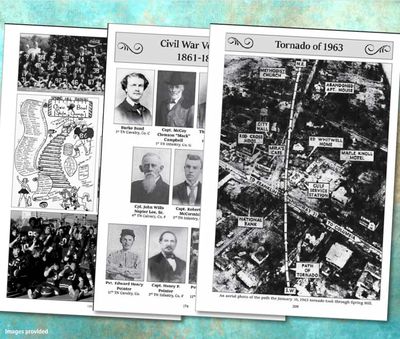
It’s involved an extensive amount of research and fact-checking, canvassing of photos, and then writing, but “Spring Hill: A Pictorial History” is now complete. It offers a fascinating glimpse into some of the people, places, and events that put this small Tennessee town on the map.
"There are some special aspects to this book," says Dana Juriew, Library Director, "and one of them is we were big on racehorses. Racehorses were bred here, and there was a track at Haynes Haven. We had a series of famous horses: Billy Direct, Brown Hal, Star Pointer, and Haynes Peacock. And Trainer Pop Geers, there’s a park for him in Columbia, he trained horses here.”
In fact, during the 1800s, Tennessee was the hot spot for breeding and racing horses in the United States (ahead of Kentucky) until the Tennessee General Assembly banned gambling in 1906.
Here’s another interesting fact highlighted in the book: Spring Hill was one of the first places to breed jersey cattle.
"There's also a lot in here about education a lot of people aren't aware of," notes Juriew. "In a town this size, you wouldn't have expected it to have had so many academies. There was a military academy here that was world class called Branham and Hughes."
Spring Hill has also been home to numerous individuals who have gained national prominence in their respective fields.
“Coo Coo and Sterling Marlin were racecar drivers. Coo Coo, whose real name was Clifton, was a four-time track champion at the Nashville Fairgrounds, then began competing in NASCAR in 1968. His son, Sterling, won the Daytona 500 in 1994 and retired from NASCAR in 2010.”
Another local resident had success in the NFL.
“McDonald Oden, who was a Cleveland Brown running back, is in here. He was one of the people who helped us write this book.”
“Spring Hill: A Pictorial History” covers the years from the Civil War to the arrival of Saturn. And it’s the many different photos that make it so interesting.
“We put callouts to the public asking them to bring in photos," Juriew says, "but a lot of them were in the Spring Hill Library collection already.
"My predecessor, Helen Dark, was the local historian and genealogist, and did a book before this one called "Spring Hill: Everybody Has a Story." So, she gathered a lot of photos for that. She’s featured in this book, also.”
Juriew says creating the book was a labor of love for everyone involved, from Spring Hill natives to newcomers who’d become attached to this community later in life. They all shared a close bond as they worked to bring the book together.
“We formed friendships and became a family," says Juriew. "But when you have a project that goes this long and given the nature of it being historical with many of our members in their eighties, it’s been a rough go because some of our members didn’t get to see it published. And we’re very sad about that.”
Two members who worked on the book and passed away were Naomi Derryberry and Billy Kinnard.
Juriew is grateful to past and current volunteers who devoted their time and effort to make this book a reality, as well as those who worked on the earlier history book that came before it.
“I think the biggest thing for me has been standing on the shoulders of the previous librarians, and Friends of the Library, who wrote the previous book and gave us all this history,” she says. “And to be able to do it as a tribute to them. I hope they would be proud of us because we had them with us throughout.”
“Spring Hill: A Pictorial History” is available for purchase at the library and local businesses, including the gift shop at Rippavilla Plantation. It costs $30, with the money raised to be used for the construction of a new library.
Pleasing homeowners with special projects
Robenstine Construction
By Pam Windsor
Things have been especially busy for Rick Robenstine in recent months. Since starting his company in Tennessee a little over a year and a half ago, Robenstine Construction has steadily increased as people began seeing the results of his work.
“We do kitchens, bathrooms, fences, decks, and basically all interior remodeling,” he explains, then notes some of their more recent projects. “We built a huge deck and pergola this past year, a very sizeable kitchen, a number of bathrooms, and much more.”
Tackling a new project is always exciting because every home (and homeowner) is different. Trends, too, are constantly changing which keeps things interesting.
“A lot of people are redoing kitchens and Shaker cabinets, all white cabinets with granite tops and quartz tops. That’s still a very popular thing right now. Another huge thing is subway tiles (three-by-five white tiles), and people are putting them in kitchens, bathrooms, backsplashes, and just about anywhere you can think of.”
Robenstine has a broad and extensive background that’s prepared him well for starting his own business. He worked for a construction company in Ohio for over a decade, did home inspections, and then worked for an investor who flipped houses. During COVID, he decided to start his own company, first in Ohio, then in Tennessee, after he and his wife, Megan, moved to Spring Hill. He’s found a strong and supportive team that supports his three guiding principles: character, communication, and integrity.
“That’s our vision statement, always doing the right thing, never cutting corners, and communicating with clients whether it’s a good thing or bad thing,” he says. “Throughout the project, whether you find something when you’re doing a complete renovation to where hey, this is going to add to your cost because we found mold behind the wall that wasn’t apparent or something like that, we want to communicate that. That’s extremely important to me.”
He's also dedicated to continuing his education and updating his certifications.
“The industry changes almost every few months, so there are different things coming out that make projects less expensive for clients while keeping the quality of work. So, learning about all that stuff consistently while you’re still carrying a workload.”
Robenstine says it’s important for people seeking a home improvement contractor to make sure the person or company is insured. And you should always ask to see photos of previous projects.
“Pictures of work definitely speak volumes,” he says. “Look for attention to detail. You want to make sure that when you’re looking at photos, they’re not missing small pieces of anything in the background. Make sure it looks like a complete project. We’ve gone in after people who’ve just built homes and ended up having to finish work.”
He takes tremendous satisfaction in going into someone's home, adding new life and energy, and making their dreams come true.
“We’re transforming people’s homes into something they never imagined. It’s very rewarding to me, and I’ve distilled that in my team, we really take pride in our work.”
To see more of Robenstine Construction's past projects, visit their Facebook page: www.facebook.com/2020remodel.
